Wednesday, October 14, 2009

Communitarian


Individualism and the Communal Christ

When God made the cosmos and everything in it, we see the oft repeated phrase in Genesis 1 and 2, "it was good." It shows up seven times, and the final time the phrase shows up was when God surveyed all he made. Then, he saw that it was "very good." So in this pristine creation of abundant goodness it strikes one as strange that God declares something in the cosmos as "not good." What was "not good" wasn't the fact that evil was a possibility (as implied in the existence of the tree of the knowledge of good and evil), nor that God's enemy was allowed to slither around and mess with things. The one thing in all of creation that was "not good" according to the voice of God himself, was the aloneness of man - Individualism.

While it is true that each human person is unique, and that there is affection between Creator and each particular individual, our view of the importance of self – the inflation of the individual and the diminishing of the community - has certainly impoverished the theology of the western church.

Our language betrays the fact that we are among the most individualistic and possessive people on the planet. Westerners (and mainly Americans in my experience) say things like "my doctor," or "my pastor," or "my hairdresser," which, when you think about it, is a little weird; as if these people are owned, and live exclusively to serve me.

It is easier for those of us in the west to live alone than most anywhere else on earth. Extended family and community are woven into to fabric of most cultures in the world and only in bizarre circumstances would a person choose to live, or even be allowed to live, by themselves.

Among the poor it is unsustainable to live alone. Most of the poor live in close (some would say crowded) community. Even street kids live in community. As a matter of fact, one hundred and fifty years ago in America most of us were farmers and we, too, had a more developed sense of community. But In the modernized, privatized, Americanized version of Christian faith, we view decision-making, relationship, and journey with Christ through an almost exclusively individualistic lens.

The idea of Christ as "personal Lord and savior," is relatively new to Christianity; and as I travel about the world I find the phrase predominantly used in the west. The ancient Jewish people, as all ancient peoples, thought of themselves collectively, and their relationship to Yahweh was more communal than it was individual. Within the early church we see whole households (which likely included related as well as unrelated people) converting to Christianity together (Acts 11:14, 16:15, 31, 18:8, I Cor. 1:16). Paul also addressed entire households in his letters, not to mention writing to communities of believers meeting in a city or region. Most cases of the word "you" in the New Testament are plural (again the English language betrays the fact that we only have one word for "you,” mostly used in the singular, unless y’all are southern). And the descriptions in the Bible of the future glory of Christ with his Bride treat the church as a collective entity.

Each individual person needs to answer the question which Jesus put to his disciples, "Who do you say I am?" We must each stand as individuals before our Maker to some degree or other. And it is appropriate to get alone with God in our prayer closets. Even Jesus went off by himself to commune with his Father. But most of us in the west, myself included, have so constructed a privatized, individualized faith, that we have lost something of the communal nature of the Godhead. My conception of heaven, my understanding of salvation, and the idea of sanctification are almost exclusively centered on me as an individual. The Christ who taught us to pray “OUR Father” has a communal understanding of heaven so far as I can see from some of the Kingdom of God parables (which often dealt with a king and his people or a landlord and his stewards). And from the description of the collective Bride comprised a great throng of people from every language and ethnic group. The call to repentance in the New Testament was almost always addressed to communities or collections of people (like Pharisees, soldiers, tax collectors, scribes, the nation of Israel or the city of Jerusalem, in addition to other entire cities). And the idea of spiritual growth, holiness, righteousness and justice are almost always expressed in communal terms.

There’s a whole lot of “one another” terminology in the Epistles and Gospels and the concept of career or even education was rarely something as individualized as it is for modern westerners. TheThe idea of a singular person deciding on their own to become a singular missionary and going on their own to spread the gospel is relatively rare in the New Testament (Philip being wisked off is the exception. There were not "missionaries" by and large, there were wandering mission communities).

We are communal people, created by a communal Godhead – God-Christ-Holy Spirit. Even our western nuclear family construct (comprised of only parents and children – or in some cases parent and child) is a frightfully smaller circle than we find in the lifestyles described in Scripture. Our understanding of the Christian faith, of God, and of ourselves is drastically shaped by an individualistic worldview driven by the concept of ME and MY.

Only by submitting ourselves to the community of Father, Son and Spirit and intentionally fostering interdependent relationships; living, eating, and serving in larger groups than most of us in the west are used to, can we come to more fully understand the God who exists in community and calls whole communities of people into fellowship with the Three in One.

------------
Recognizing what a communal person I've become and missing that here in SF! So here's another reason why I feel called to live in a developing nation, at least for some time if not forever.

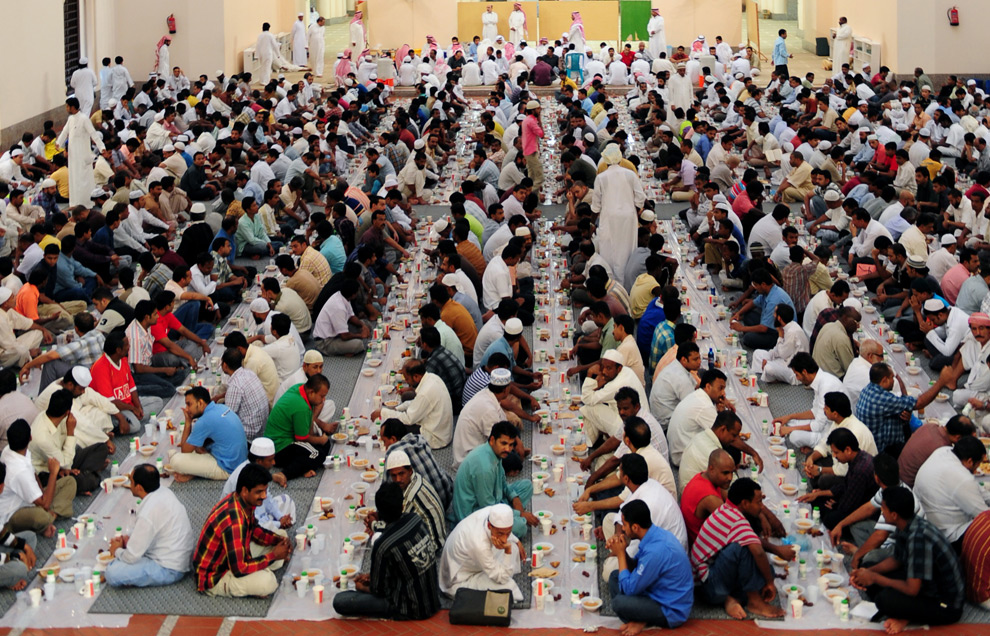
Also, I think Ramadan is one of the most beautiful communal celebrations ever. Perhaps I'll be ministering and celebrating in a Muslim country one day...
And did I mention dates are one of my favorite foods ever? The date palm has an amazing story behind it too. Ramadan is date galore.



I absolutely adore wet markets!!

Poverty III

III. Poverty: Not in the Congregation
Posted At : October 10, 2009 11:30 AM

This is part 3 of a four-part series. Part II was in my previous note.

When God made the heavens and the earth, he did not create slums. His creation was made to be in a state of flourishing, benevolently governed by humans made in his image. Later, God set his affections on a slave race in order to demonstrate to the world his intentions for human shalom-prosperity-flourishing, and set up an economic and social system so that "there should be no poor" among them (Deut. 15:4); they would lend to many nations but would never need to borrow (Deut 28:12). Land would be redistributed on a regular schedule (Lev. 25) and debts were forgiven on a seven-year cycle (Deut. 15) in order to insure no one would be driven so deep into poverty that they could never get out.

In the early days of the church we glimpse once more God's offense at poverty and his intention to establish a poverty-free kingdom.

When Paul and Barnabas went before the Apostles to be certain that their kingdom-building efforts among the Gentiles were not in vain, "They asked only one thing, that we remember the poor, which is actually what I was eager to do." (Gal. 2:10). Of all the theological issues the Apostles might have emphasized to Paul and Barnabas in the early days of establishing the church, their only concern was that Paul knew the importance of remembering (or caring for) the poor.

The church, like the nation that God established among the former Hebrew slaves, was to be a place where poverty was non-existent, or at least a rare exception. The early followers of Jesus entered into a community without private ownership or personal hoarding. As a result, they lived a reality that did not include poverty:

Now the whole group of those who believed were of one heart and soul, and no one claimed private ownership of any possessions, but everything they owned was held in common. With great power the apostles gave their testimony to the resurrection of the Lord Jesus, and great grace was upon them all. There was not a needy person among them, for as many as owned lands or houses sold them and brought the proceeds of what was sold. They laid it at the apostles' feet, and it was distributed to each as any had need. Acts 4:32-35 (Also see Acts 2:44).

In order to eradicate poverty from among them, the followers of Jesus not only denounced private ownership and embraced the idea of communal wealth, but they undertook social programs, such as daily distribution of food to widows. Such systems required time, effort, intention, and a layer of management which they dubbed "servants," (diakonos in Greek) or Deacons. These were the systems and structures adopted to insure that “there was not a needy person among them,” (Acts 4:34) or in the words of the Old Testament Law, “there should be no poor among you.” (Deut. 15:4)

The church was an organism which was to express Christ's kingdom on earth. As such, poverty would not be tolerated. John the Baptist, Jesus, Peter, Paul and James all addressed issues of poverty and wealth in their teachings which indicated God's intent that his image-bearers might live lives of material sufficiency and radical generosity.

But what of Jesus' statement that, "you always have the poor with you," (Matt 26:11, Mk 14:7, Jn 12:8)? The point of Jesus’ comment was that showing kindness to the poor is something the disciples would have ample opportunity to do, but that anointing Jesus' body for burial was not. The concern about using the anointing money to help the poor was a deception anyway. It was something Judas Iscariot raised because his intent was to take the money for himself (Jn 12:6). His concern was not for the poor. Jesus' statement is not resignation to poverty. His words do not encourage us to accept poverty any more than if he had said "there will always be brothels," would encourage us to accept sexual exploitation. Sin may not be completely eliminated before his return, but this is not license for us to allow evil to flourish.

In God's abundant creation, in the national laws that he established for his people, and in the teachings of Christ and the operation of the early church it is clear - Poverty is anathema for those who know, love and follow the God of the Universe and its existence is an offense to be addressed by his people.

-From Urbana.com
---------

So God has made it exceedingly clear to me that he wants me to do something about the poor of this world. I've seen way too much in my short life to just stand idly on the sidelines. I'm not sure about much in my future, but this passion seems to follow me wherever I go. I can't evade it.

Being back in SF, a city filled with fancy houses and cars makes it tempting to go and fulfill my fleshly desires. But I know that ultimately, even if I could dine in the finest restaurants every night or live in the most beautiful Victorian mansion, I would never be truly content. Plus, God's nature and people make a better home any day.

The cool thing is, I know that I would find joy in living simply--even though the world says otherwise. I can totally imagine myself living in a small town in a developing country, not missing the luxuries of America too much. My mom and sisters obviously do not think so--> What a waste of a good Williams education if I don't go out there and make millions.

So I pray for a heart that is willing to submit to God's radical plans. Been reading Ephesians lately and thinking about Paul--what an encouragement and inspiration he is in this regard. For once, I am feeling like Paul is a dear friend and brother rather than someone who is literally above and beyond :)

Poverty II

II. Poverty: Not in God's Nation
Posted At : April 18, 2009 9:58 PM

This is part II of a four part series.

When humanity chose oppression and exploitation over caring for one another and for God’s creation, God decided to show the world how things ought to work through a single nation. He chose the family of Abraham to display to the entire planet what a kingdom ruled by his principles might look like.

God waited until this family had become slaves to an oppressive nation that was executing a kind of genocidal population control by killing all Hebrew baby boys (see Exodus 1). God figured that since this slave race knew first hand what oppression felt like, they would be careful not to oppress others.

“True justice must be given to foreigners living among you and to orphans, and you must never accept a widow’s garment as security for her debt. Always remember that you were slaves in Egypt and that the Lord your God redeemed you from your slavery. That is why I have given you this command.” Deuteronomy 24:17-18 (NLT)

Since humans were not responding to our genetic encoding – made in God’s image to govern in such a way as to create and inspire human and environmental flourishing – he gave these liberated slaves specific instructions which they referred to as The Law. If they followed it the world would see how things were meant to be.

“There should be no poor among you, for the Lord your God will greatly bless you in the land he is giving you as a special possession. You will receive this blessing if you are careful to obey all the commands of the Lord your God that I am giving you today.” Deuteronomy 15:4-5 (NLT).

Imagine it. An entire nation without a single poor person. But God knew our penchant to stray from his principles, and he knew that a nation like this would be such good news to the poor from surrounding nations that there would always be someone in need in the land. So just to be sure we understood that a nation under his laws would not permit poverty to survive for long, he laid out some additional safeguards.

Anyone who loaned money was commanded to forgive any and all debts every seventh year. And every fiftieth year people who had acquired a lot of property, either because of the misfortune of others or because of their own business prowess, were required to give it back to the family from whom they had bought it. This would be a society where there were no super rich or super poor, where everyone was commanded to be open handed with their resources.

“But if there are any poor Israelites in your towns when you arrive in the land the Lord your God is giving you, do not be hard-hearted or tightfisted toward them. Instead, be generous and lend them whatever they need. Do not be mean-spirited and refuse someone a loan because the year for canceling debts is close at hand. If you refuse to make the loan and the needy person cries out to the Lord, you will be considered guilty of sin. Give generously to the poor, not grudgingly, for the Lord your God will bless you in everything you do. There will always be some in the land who are poor. That is why I am commanding you to share freely with the poor and with other Israelites in need.” Deuteronomy 15:7-11 (NLT)

The agricultural and societal laws that God gave to this former-slave nation were designed to guard against greed and exploitation and insure that the weak and powerless were defended by law. Poverty could not exist in a family for more than one generation in such a society, nor would any family have to suffer the terrible illusion that they were independent of God because they had become so wealthy (either by accumulating interest on debts or by accumulating other people’s property).

Give me neither poverty nor riches; feed me with the food that I need, or I shall be full, and deny you, and say, "Who is the Lord?" or I shall be poor, and steal, and profane the name of my God. Proverbs 30:8-9 (NRSV)

Poverty was not part of creation when God dreamed up the world at the beginning. It came about as a result of the Fall. And when God established a nation of freed slaves, poverty would not be part of their reality if they followed his laws. Unfortunately the slaves forgot what it was like to be oppressed and became oppressors themselves. Poverty remained part of the picture.

God's next attempt to rid us of this scourge came when the Church was born. Stay tuned for Part III.

-From Urbana.org

I am so convicted! Most recently, I have been coming to a clear realization of the utter insignificance of material wealth once we reach the threshold of material sufficiency. More money rarely, if ever, leads to true joy, but almost invariably invites trouble and an insatiable hunger for more.

Realizing that I have more than enough now and will always live under divine providence liberates me to take risks for God. And stepping out on faith for the building of God's kingdom here on earth has always resulted in deep fulfillment and joy. So dare to dream big! Because God always seems to use the little people like you and me to accomplish unimaginable feats through his amazing grace (and of course, all for His glory throughout the heavenly realms).

"When fear shapes our lives, safety becomes our God. When safety becomes our God, we worship the risk-free life. Can the safety lover do anything great? Can the risk-averse accomplish noble deeds? For God? For others? No. The fear-filled cannot love deeply. Love is risky. They cannot give to the poor. Benevolence has no guarantee of return. The fear-filled cannot dream wildly. What if their dreams sputter and fall from the sky? The worship of safety emasculates greatness." -Max Lucado, Fear.

Sunday, October 11, 2009

It's a dark and dreary in the city by the bay. But I am feeling oddly alive. I am sitting at my wooden desk reminiscing of the snowy Saturday mornings in Williamstown...the warmth of the old entry dorms, brunches at driscoll, tunes of the chapel bells. Hmmmm good times. I am realizing just how precious those years were. Never would I have imagined spending such long winters in a cozy brick dorm, in a little farm town nestled in the mountains thousands of miles from home.

It's one of those days when all you want to do is bundle up and read a good book in bed. (Though I don't think I've ever let myself indulge in such a thing!) Work just never seems to end. One of these days, I'll have to learn.

Life has been good. A lot of wandering around the dark...experimenting with different jobs, building relationships, doing the things I've always wanted to do but have been too busy or afraid to do. One of those things is social dancing. I never knew how glorious it feels to soar across the dance floor. As the music flows, time stops and you forget all your preoccupations. I think I'm in love.

--------------

I met a little angel today in church. She sat two seats away from me and loves to sing the same songs that I love to sing. We had an instant connection when the music started and she ended up moving to the seat next to me. I am excited to see her again next Sunday.